Benefits
- Flexible product design and wall thickness
- High strength-to-weight ratio
- Heat and chemical resistance
- Electrical insulation
- Dimensional stability
- Low thermal conductivity
- Water and corrosion resistance
- Wide range of colours and finishes
Material Expertise
Thermosets, engineering thermoplastics and dual-laminate construction for demanding corrosion-resistant applications.
Request Material Review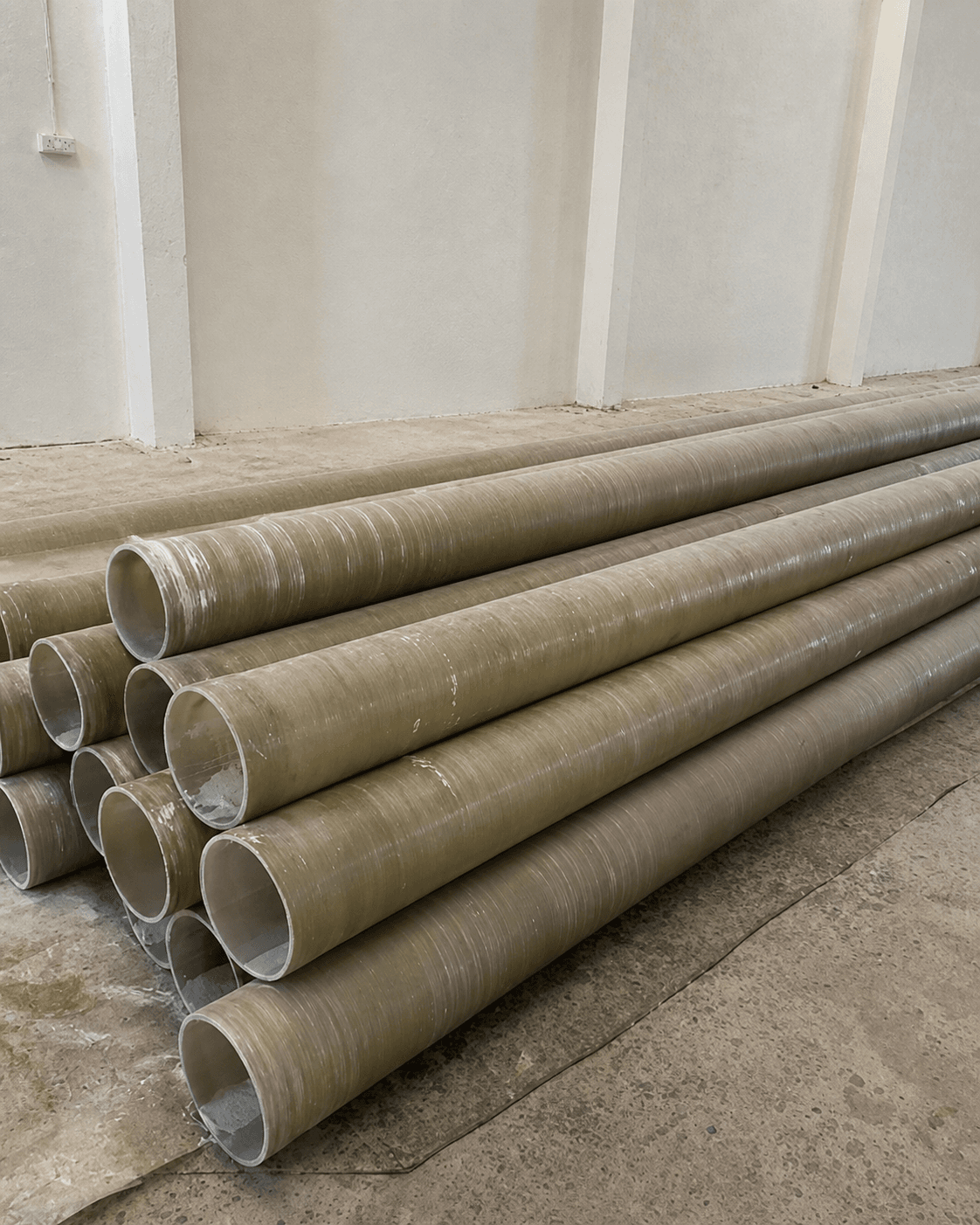
Composite material capability
AMPAR combines material selection with controlled fabrication to produce corrosion-resistant piping and process equipment for reviewed chemical, temperature, pressure and mechanical conditions.
The finished system depends on more than the base material. Resin systems, reinforcement, liner construction, wall thickness, joining methods and quality controls must work together for the intended service.
Discuss Material RequirementsInitial comparison
Use these indicative values only for early-stage comparison. They do not replace chemical-resistance data, pressure derating, welding factors or project-specific engineering.
| Material | Indicative maximum temperature | Commonly considered for |
|---|---|---|
| PP | Up to 95°C | General chemical service |
| PPH | Up to 100°C | Chemical tanks and process equipment |
| HDPE | Up to 60°C | Storage and water duties |
| PVC | Up to 60°C | Acids and alkalis |
| CPVC | Up to 95°C | Hot corrosive chemicals |
| PVDF | Up to 140°C | High-purity applications |
| ECTFE | Up to 150°C | Highly aggressive chemicals |
| FEP | Up to 205°C | High-temperature service |
| PFA | Up to 260°C | Extreme corrosion resistance |
1. Thermoset Plastics
Thermoset plastics begin as resins and harden through heat or a chemical curing reaction. Curing creates permanent cross-links that hold the molecular structure in place, so the finished material cannot be melted and returned to its original liquid state.
Their structural integrity and resistance to heat and chemicals make thermosets valuable in composite process equipment, electrical housings and other demanding applications.
2. Thermoplastics
Thermoplastics are solid at room temperature and soften when heated beyond their melting or glass-transition range. Because processing does not create permanent cross-links, they can be reheated, formed and, in many cases, recycled with limited impact on their material properties.
Extrusion, thermoforming and injection moulding produce components with useful elasticity, strength and chemical resistance. Their temperature sensitivity must be reviewed for every application.
Applications
Thermoset composites support chemical processing, construction, electrical, energy, transportation and other duties requiring structural robustness and corrosion resistance.
Thermoplastics are widely used in chemical, water, electronics, medical, food, automotive, construction and plumbing applications where their processability and corrosion resistance are valuable.
3. Dual Laminate Technology
Dual laminate combines a corrosion-resistant thermoplastic liner with an FRP structural shell, delivering superior chemical resistance and mechanical strength.